Why do property taxes keep going up?
DuPage County Property Taxes Explained: Why are taxes insanely high and Illinois the 2nd-highest in the US?
If you own a home in DuPage County, you already know the feeling: the tax bill arrives, it’s higher than last year, and no one ever quite explains why. Let’s fix that.
Illinois has the 2nd-highest property taxes in the country
Illinois homeowners carry one of the heaviest property tax burdens in the nation. The state’s average effective rate sits around 2.07% of home value — roughly double the national average — and in 2024 Illinois tied for the highest residential property tax rate in the United States.
What that means in real dollars: the average Illinois family pays about $6,285 a year in property taxes, compared to a national average of $2,969. That’s more than $3,000 in extra cost, every single year, simply for choosing to live here. For comparison, neighboring Indiana’s effective rate is 0.76% and Wisconsin’s is 1.32% — a gap that helps explain why Illinois keeps losing residents to both.
Where your DuPage County property taxes actually go
Here’s the breakdown most people never see:
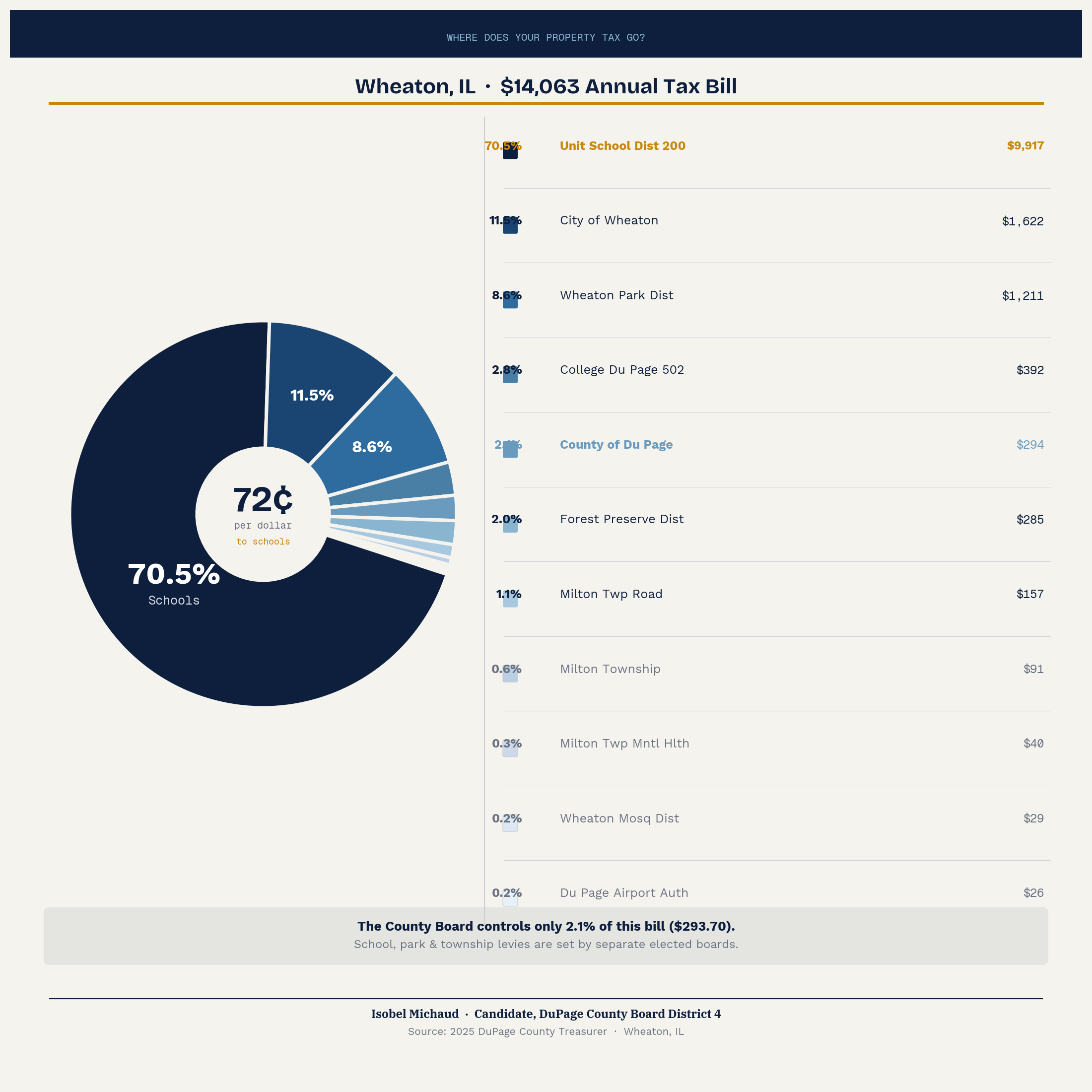
- Local school districts: ~70–75%. The single largest share of your bill by far.
- Townships and special districts (parks, fire, libraries): ~15–20%.
- Your village or municipality: a smaller slice.
- DuPage County government: about 2%. On a total county levy of roughly $3.61 billion, county government receives about $71.5 million.
Why your bill keeps climbing: state, schools, and other local drivers
Rates this high aren’t an accident, and they aren’t mostly about waste at the county level. They’re structural — and they’re worth understanding before you vote.
- Illinois funds schools through your home. Instead of relying primarily on state income or sales taxes, Illinois pushes the cost of public education onto local property. That’s why schools are 70%+ of your bill, and it’s the root cause of the burden.
- Pension cost-shifting. A growing number of school districts now cover all or part of teachers’ required pension contributions — costs employees are supposed to pay themselves. That burden gets quietly added to your property tax bill, and many homeowners don’t even realize it’s happening.
- Pensions are crowding out services. In Cook County, 75% of the police and fire property taxes collected outside Chicago went to pensions rather than actual protection — roughly $450 million of a $599 million levy. You’re paying for safety and receiving, increasingly, legacy costs.
- Special carve-outs shrink the base. Tax-increment financing (TIF) districts divert enormous sums out of the general tax base — in Cook County alone, an estimated $2 billion that taxpayers effectively made up elsewhere. Every dollar carved out is a dollar shifted onto ordinary homeowners.
- Billing dysfunction adds real cost.When property tax bills are delayed, school districts are forced to borrow to cover operations — one recent Cook County delay generated roughly $122 million in unnecessary borrowing costs. Inefficiency at the system level lands on you.
- Billion-dollar deals with murky returns. Large special deals — like the proposed Bears stadium legislation — risk leaving property taxpayers on the hook for benefits that are uncertain at best. Lawmakers too often make these commitments without fully understanding the consequences.
What a County Board member can—and can’t—do
Honesty matters here. The DuPage County Board serves important duties, but only a small portion of your total property tax bill. A County Board member cannot single-handedly lower your entire tax bill, because the county controls so little of it. Anyone who promises otherwise isn’t being straight with you.
While only 2% of Dupage County property taxes go to the DuPage government, it’s clear that local government, from townships to school boards to county board positions, are key in determining how much you pay in property taxes and how much DuPage County property taxes may rise in a given year and long-term.
Local elections carry real pocket-book consequences:
- Hold the county levy flat. Zero increase to the 2% the county controls — no exceptions.
- Demand spending efficiency. Competitive bidding, outcome-based budgeting, and refusing to waste the dollars we do collect.
- Pressure Springfield for structural reform. The pension cost-shifts and school-funding model driving your bill are state-level problems — not the county’s to fix alone, but absolutely the county’s to fight for.
- Grow the commercial tax base. More economic development means the residential burden is shared more broadly, easing the load on homeowners.
The bottom line
DuPage County property taxes amount to an effective rate (about 1.95–2.2%), which is actually lower than neighboring Lake (2.4%), Will (2.3%), and Kane (2.3%) counties — but it’s still far above the national average, because the whole state is built on a property-tax-heavy model. The fix starts with telling residents the truth about what their elected officials can actually change, and then changing it.
DuPage residents deserve exactly that.
Property Taxes Fast Facts Q&A
- Q: Why are DuPage County property taxes so high? → State funds schools through property, not income/sales tax.
- Q: How much of my bill does the County control? → About 2%.
- Q: How does DuPage compare to nearby counties? → Lower than Lake, Will, and Kane, but above the national average.
Isobel Michaud is running for DuPage County Board, District 4.
Sources: Illinois Policy Institute (2025); JVM Lending DuPage County Guide (2026); Civic Federation; DuPage County Treasurer. U.S. States with Highest Property Property Taxes (2026)