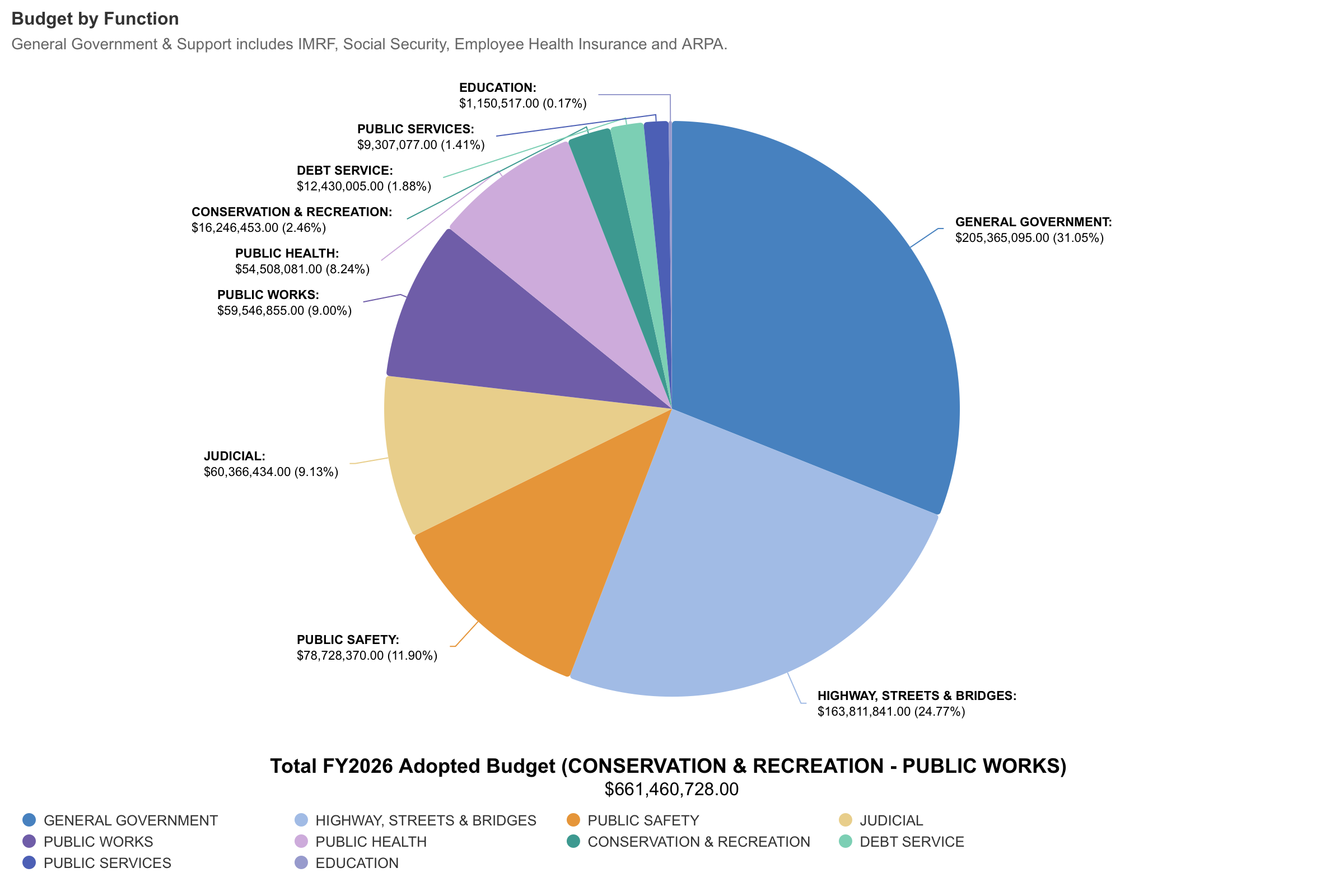
Where Does Your $661.5 Million Go? A Taxpayer’s Guide to the DuPage County FY2026 Budget
The DuPage County budget for Fiscal Year 2026 has just been adopted — $661.5 million in total spending, funded in large part by your property and sales taxes. Most residents will never open the budget book or the County’s Interactive Budget Book on OpenGov. That’s exactly the problem. If we want a county government that’s accountable, we have to start by understanding where the money actually goes.
Here’s the plain-English version, and where I think DuPage County can do better by its taxpayers.
The Big Four: Where the DuPage County Budget Goes
Four categories account for nearly three-quarters of the entire county budget:
General Government — $205.4 million (31.1%). This is the largest slice by far, and it’s not just “administration.” It includes the Illinois Municipal Retirement Fund (IMRF), Social Security contributions, employee health insurance, and remaining ARPA-funded programs.
Highway, Streets & Bridges — $163.8 million (24.8%). Road construction, maintenance, and the infrastructure that keeps DuPage moving.
Public Safety — $78.7 million (11.9%). The Sheriff’s Office, corrections, and countywide public-safety operations.
Judicial — $60.4 million (9.1%). Courts, the State’s Attorney’s Office, and related judicial functions.
The remaining 28% is spread across Public Works, Public Health, Conservation & Recreation, Debt Service, Public Services, and Education.
From Proposal to Adoption: The Budget Grew Mid-Process
When Board Chair Deborah Conroy first presented her spending plan, it totaled $644.7 million, with the General Fund at $263.1 million — described at the time as the smallest General Fund increase since 2021. By the time the County Board adopted the final FY2026 budget, total spending had climbed to $661.5 million. That’s nearly $17 million added between proposal and adoption — the kind of gap that deserves a public explanation, not a footnote.
To be fair to the County: the property tax levy itself, $71.5 million, captured new construction without raising the tax rate, which stays flat at roughly 2% of the average homeowner’s bill. A home valued at $350,000 will owe about $129 in county property taxes this year. That’s a real, measurable restraint — and it’s worth acknowledging alongside the questions.
The Four-Year Trend: Growth Outpacing Inflation
Look at the total adopted DuPage County budget over the last four years and a pattern emerges:
FY2023: $586.0 million
FY2024: $625.0 million
FY2025: $636.6 million
FY2026: $661.5 million
That’s nearly 13% growth in three years — faster than inflation over the same period. A meaningful share of that growth rides on sales tax revenue, which means DuPage County’s budget health is tied more tightly to the business cycle than most residents realize. When the economy slows, so does county revenue, and the spending commitments built during good years don’t automatically shrink with it.
Why This Matters for DuPage Taxpayers
None of this means the county is being reckless. DuPage maintains a AAA bond rating from all three major rating agencies — a distinction only about 1.6% of counties nationwide can claim. Fiscal discipline exists here. But a growing DuPage County budget, an increasing reliance on cyclical revenue, and a $17 million gap between proposal and adoption are exactly the kind of details that deserve scrutiny from someone willing to read the whole budget book, not just the press release.
Where I’ll Be Looking for Savings
As your candidate for DuPage County Board, District 4, fiscal responsibility isn’t a talking point — it’s one of the six pillars of my platform, alongside public safety, small business growth, education for an AI generation, a return to common sense, and government accountability. Over the coming weeks, I’ll be publishing a full breakdown of this budget, function by function, and flagging specific places where I believe DuPage County can spend smarter without cutting the services residents actually rely on.
Want to follow along? Join the campaign to get the next installment of this budget series directly, or find out how to vote for a County Board member who reads the whole budget book.
Sources: DuPage County Financial & Budget Plans, DuPage County Board Approves Fiscal Year 2026 Budget, DuPage County Interactive Budget Book (OpenGov), Positively Naperville: DuPage County Board Chair Presents Balanced Budget for FY2026.
Paid for by Friends of Isobel Michaud.


DuPage County Revenue Explained: Where the Money Comes From
September 24, 2026[…] my FY2026 budget breakdown, I followed where your $661.5 million goes. This is the other half: DuPage County revenue, or where […]